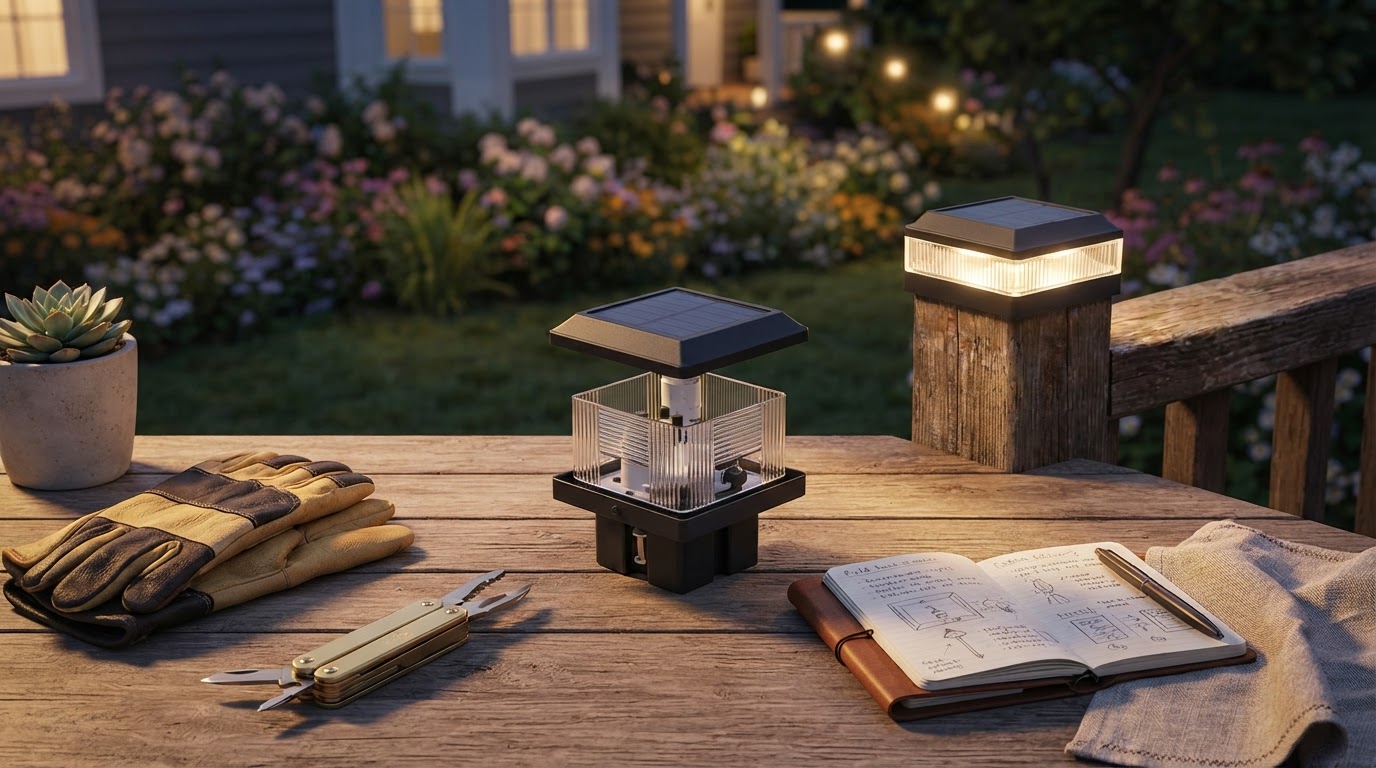
Automating Solar Fence Post Lights for Nighttime Property Use
 Maya ChenContributing Editor
September 20, 2026. This analysis evaluates the technical efficiency of automated dusk-to-dawn sensors within residential perimeter lighting systems. It is intended for property owners prioritizing long-term hardware reliability over aesthetic trends.
The Efficiency Gap in Automated Perimeter Lighting
The conventional wisdom says that all solar fixtures are created equal as long as they face the sun. However, the performance gap between generic hardware and purpose-built automated sensors is significant. Most homeowners assume that "dusk-to-dawn" is a binary feature, yet the actual discharge curve of the internal battery often fails before the sunrise phase. According to Superior Lighting, high-output units like their 10-watt solar LED models can produce 1000 lumens, but maintaining that output throughout a full cycle requires specific circuitry that many entry-level post caps lack. When integrating waterproof solar fence lights outdoor, the primary failure point isn't usually the LED itself, but the degradation of the photo-resistor that triggers the automation. If the sensor is poorly calibrated, the light may activate during heavy overcast periods, depleting the battery before the actual night begins. This creates a security vulnerability that many users overlook until the fixture fails to trigger during a critical midnight window. Furthermore, the industry consensus often ignores the impact of ambient light pollution on these sensors. A streetlamp or a neighbor's floodlight can trick a low-sensitivity dusk-to-dawn sensor into remaining off, rendering the entire installation useless for its intended purpose.
Technical Realities of Solar Fence Post Lights
Here's the part nobody talks about: the math of solar energy harvesting rarely supports high-lumen output for twelve consecutive hours in non-ideal climates. Run the math: a standard solar cell on a fence post light receives a limited number of peak sun hours, especially when mounted on the north side of a property or under a tree canopy. To achieve true dusk-to-dawn functionality, the hardware must balance the draw between the sensor's idle power and the LED's active consumption. For those utilizing 4x4 solar post caps, the surface area for photovoltaic collection is physically constrained by the dimensions of the timber. This is why high-end solar fence post lights focus on lithium iron phosphate (LiFePO4) batteries, which handle deeper discharge cycles more effectively than the nickel-metal hydride (NiMH) alternatives found in bargain bins. When consumers search for solar vinyl fence lights, they are often looking for a set-and-forget security solution, but without a high-quality dusk-to-dawn sensor, these lights become intermittent at best. Data from Bulbs.com indicates that professional-grade solar powered dusk to dawn lighting fixtures, including those from brands like Light Efficient Design, are increasingly moving toward multi-mode sensors that dim the light during inactive hours to preserve battery life for the dawn period. This adaptive brightness is the only way to ensure the light actually stays on until the sun rises, rather than dying at 2:00 AM.
A Framework for Evaluating Automated Solar Hardware
Choosing a fixture based on the box art is a recipe for hardware failure within six months. A rigorous evaluation of solar fence post lights requires looking at the discharge specs and sensor sensitivity rather than just the lumen count. While the GE Outdoor Security Area Light offers up to 1,200 lumens with a dusk-to-dawn sensor, that level of output is only sustainable with a substantial solar panel array that most fence posts cannot support. Therefore, the decision must be based on the specific footprint of your installation and the environmental stressors of your region. When selecting fixtures, use this technical checklist:
- Verify the battery chemistry: LiFePO4 is mandatory for dusk-to-dawn reliability in fluctuating temperatures.
- Check the IP rating: For waterproof solar fence lights outdoor, an IP65 rating is the minimum standard for preventing sensor corrosion.
- Assess the sensor placement: Ensure the photo-resistor is shielded from internal light leakage, which causes "strobe" cycling.
- Calculate the solar-to-battery ratio: The panel should ideally be able to fully charge the battery in 5-6 hours of indirect light.
- Review the mounting hardware: Solar fence lights for security must be anchored with anti-tamper screws to prevent easy removal.
- Confirm the Kelvin temperature: 5000K (Daylight) provides better visibility for security, while 3000K (Warm White) is preferred for residential ambiance.
Shop Solar Fence Post Lights here
Sources
- Solar Dusk-to-Dawn Light, 1000 lm, Pole Mount, 5000K
- GE Outdoor Security Area Light, Motion & Dusk to Dawn Sensor ...
- Top 5 Best Solar-Powered Dusk-to-Dawn Lights of (2026)